




Nature Conservation Order NCO

|
| Seton Sands and the Firth of Forth, which was designated as an NCO in 2006. |
Contents |
[edit] Introduction
In Scotland, Nature Conservation Orders (NCOs) are made to prevent damage to the natural features of specific areas of land. The Orders set out certain prohibited operations and the land to which they apply. NCOs may be issued by Scottish Ministers in situations where there are no other protective measures in place.
In England and Wales these measures are referred to as Special Nature Conservation Orders (SNCOs).
[edit] Where NCOs apply
An NCO may apply in or around certain designated areas, including:
- Sites of Special Scientific Interest (SSSI) as designated under the provisions of Chapter 2 of the Nature Conservation (Scotland) Act 2004.
- Within Natura sites as designated under Regulations 19 and 20 of the Conservation (Natural Habitats, &c.) Regulations 1994.
- Outside SSSI or Natura sites where Scottish Ministers deem there is special interest in natural features.
- Bordering or otherwise associated with any of the aforementioned types of land.
In August 2019, an NCO was made to prevent damage to, and removal of, Jurassic vertebrate fossils on Skye.
[edit] Sites of Special Scientific Interest and Natura sites in Scotland
Sites of Special Scientific Interest (SSSIs) are essential building blocks for nature conservation in Scotland. They are areas of land and water that serve as natural representations of Scotland’s natural heritage in terms of its flora, fauna, geology, geomorphology and a mixture of these natural features.
Many SSSIs are also designated as Natura sites – whether as Special Areas of Conservation (SAC) or Special Protection Areas (SPAs).
Natura sites are designated under the European Habitats and Birds Directives. Natura sites are intended to protect plants, animals and birds – some which are considered rare, endangered or vulnerable.
Natura sites are viewed as internationally important for threatened habitats and species. These sites are part of a collection of protected areas throughout Europe.
One additional piece of legislation, the Habitats Regulations, provides protection for SACs and SPAs in Scotland. This ensures that any plan or project that may damage a Natura site is assessed and can only proceed if certain strict conditions are met.
For more information see: Habitats regulations assessment.
[edit] Consequences of violating an NCO
Breaching an NCO is considered an offence. These protections are put in place to make it illegal to perform certain activities in specific areas and during designated time periods.
[edit] Related articles on Designing Buildings Wiki
IHBC NewsBlog
Busaries open for IHBC's Annual School 10-12 June 2027

Apply for funded places for #IHBCBristolBath2027 until 1 February 2027
London's oldest restaurant given to National Trust

Rules will continue to open and income will fund conservation
No right to cross-pavment charging in England's conservation areas

Residents excluded from new permitted development rights
Save the Date for #IHBCBristolBath2027 on 'Climate Change & Significance'

Register now for updates on IHBC's Annual School 10-12 June 2027
Bath could pause UNESCO World Heritage Site status
Consultation on scheme to hit housing targets runs until 30 October 2026
Canals offer increasing innovation opportunities
Canal & River Trust sees canals playing role in UK's water security
IHBC sponsors Gardens Trust event 23-4 Sept 2026
.jpeg)
'Learning from the Past, Shaping the Future’ takes place in Milton Keynes
Renovations to Frank Lloyd Wright's Fallingwater complete
.jpg)
World Heritage Preserved project opens house for tours again
Shakespeare Birthplace Trust places Hall's Croft on HAR Register
Stratford-upon-Avon home of Shakespeare's daughter is 'At Risk'
Lady Grange’s House repaired on St Kilda
.jpg)
National Trust for Scotland repairs stone cleit with link to famous island resident
Griff Rhys Jones on BBC Radio 4 Today programme
,_Green_Lane,_Derby.jpg)
The Victorian Society’s President unveiled its latest Top Ten Endangered Buildings 2026.
Need a MATE? Book your place now.

IHBC offers free webinars on applying for IHBC accreditation (Full & Associate).
UK Stained Glass Repository finds windows new homes
How are stained glass windows are rescued, stored and repurposed?
APPGEBE report sets high aims for quality
'Government must not sacrifice quality in drive to build 1.5m homes'
New measures protect Historic Shipwrecks from heritage crime

Underwater cultural heritage benefits from new HE guidance
How could the City of London skyline look in 6 years' time?

Visualisation shows approved planning applications as completed buildings
National Trust for Scotland calls for VAT cuts

Heritage neglect is encouraged by current policies
IHBC's 'Context' Issue 186 features Industrial Heritage

IHBC's members' journal reports on the challenges of conserving infrastructure
Book now for IHBC Annual School 2026

IHBC Annual School is taking place 18-20 June 2026 in Newcastle
RICHeS Research Infrastructure offers ‘Full Access Fund Call’
RICHeS offers a ‘Help’ webinar on 11 March
Latest IHBC Issue of Context features Roofing
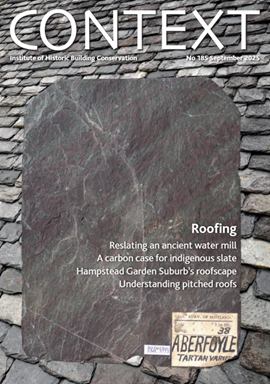
Articles range from slate to pitched roofs, and carbon impact to solar generation to roofscapes
Three reasons not to demolish Edinburgh’s Argyle House

Should 'Edinburgh's ugliest building' be saved?
IHBC’s 2025 Parliamentary Briefing...from Crafts in Crisis to Rubbish Retrofit
IHBC launches research-led ‘5 Commitments to Help Heritage Skills in Conservation’
How RDSAP 10.2 impacts EPC assessments in traditional buildings

Energy performance certificates (EPCs) tell us how energy efficient our buildings are, but the way these certificates are generated has changed.